The capacity system of record

Where the work actually goes — without a timesheet.

Time, capacity, and cost — captured automatically from the tools where work happens. No timesheets. No surveys.

The shape of the system

Zero entries. Nine systems. One ledger.

Tymr listens to the tools where work happens. The work doesn't change — the receipt does.

Workers fill in
0

Zero entries.

Tymr drafts time from the systems where work already happens. Review in under a minute — or don't.

Auto-drafted · Privacy Shield enforced
Systems on the wire
9

Nine systems.

Calendar, chat, ticketing, ITSM, HRIS, dev tools. One normalized event stream, lineage preserved end-to-end.

Calendar · chat · ticketing · ITSM · HRIS · dev
What you get back
1

One ledger.

Capacity, project cost, OpEx/CapEx, portfolio scenarios. Humans and agents in the same lens.

Compliance artifacts as a byproduct
The problem

Timesheets are a tax on the people doing the work — and the data you get back isn't true anyway.

Workers don't fill them in. The ones who do, pad. Leaders make decisions on numbers that were never real.

What actually goes wrong

One missing signal. Five broken decisions.

When time data is fiction, everything riding on it is fiction too.

  • Workers spend hours on timesheet hygiene everyone knows is half-real.
  • Managers fly blind on capacity until a deadline slips.
  • PMOs miss projects because the team was already over-allocated.
  • Finance can't split OpEx from CapEx until quarter-close.
  • Executives approve portfolio shifts on data nobody trusts.
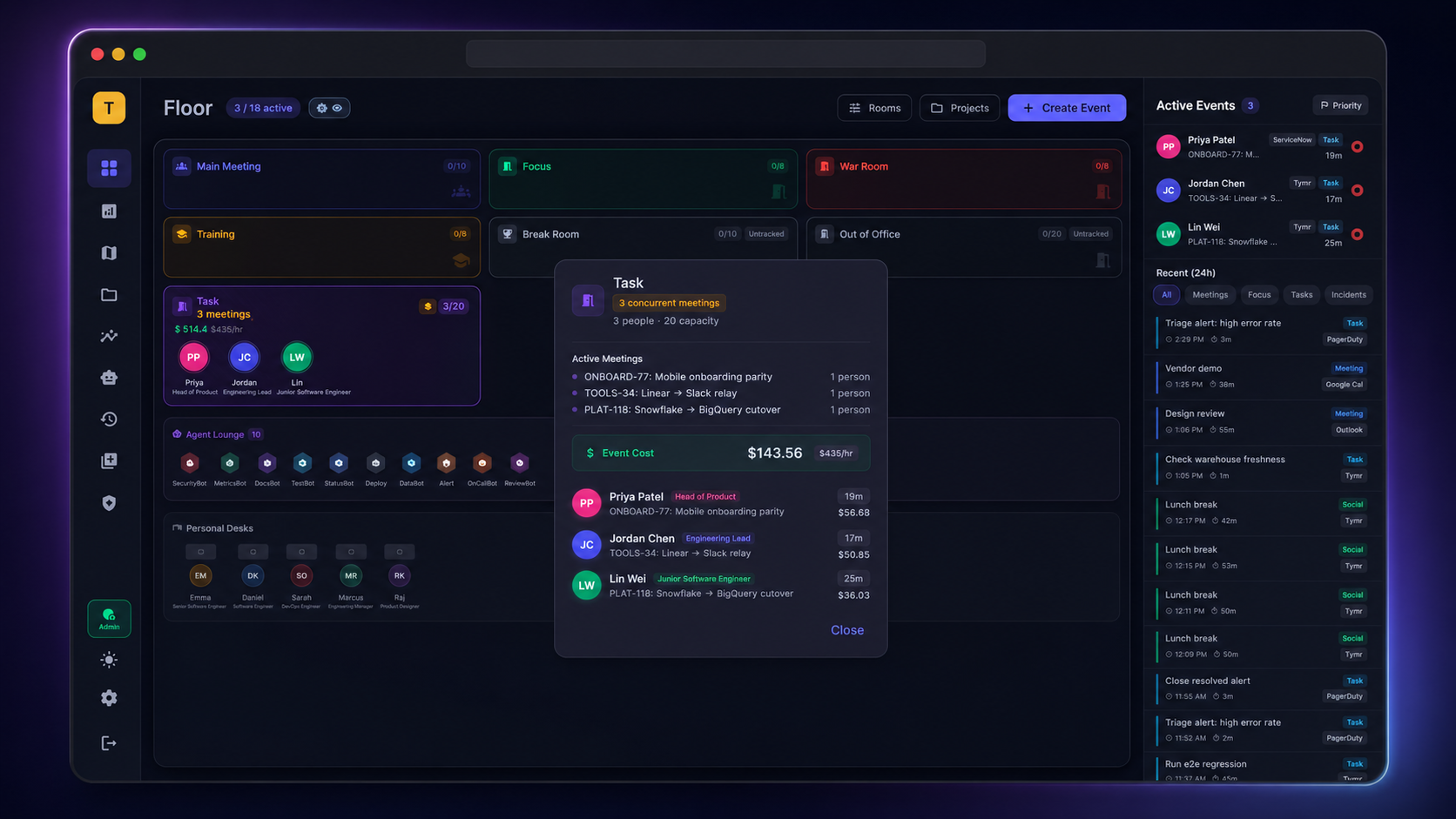
app.tymrlogic.com / floor
Tymr floor view — live work in progress, humans and agents on one grid
Floor — live capacity, no timesheets in sight Streaming
How it works

Work happens in your tools. Tymr turns it into a single ledger.

Four stages. Workers see none of it.

01 · Sources

Nine systems on the wire.

Calendar, chat, ticketing, ITSM, HRIS, dev tools. OAuth, read-only. Humans and agents emit the same shape.

9 sources · OAuth · read-only
02 · UTE

One open event format.

Every signal becomes a Universal Time Event — vendor-neutral, lineage-preserving, replay-safe.

UTEv1 · open spec
03 · Attribution

Hours, projects, cost.

Each event attributed to a worker, project, and activity with confidence scores. Ambiguity gets a short review, not a survey.

Per-worker · per-project · per-activity
04 · Outputs

The single ledger.

Capacity, project cost, OpEx/CapEx, portfolio scenarios. One source — many views.

One ledger · many views
Project cost

Labor + Non-Labor

Hours plus contractors, infrastructure, consulting. One column. Complete the first time.

Accounting split

OpEx / CapEx

Expense work split from balance-sheet work — project by project, in real time.

Strategic

Portfolio Scenarios

Move people and agents across initiatives. See capacity and cost shift before you commit.

Operating

Live Event Cost

Every meeting, incident, and agent run carries a dollar weight in real time.

Byproduct

Compliance artifacts

R&D credit, software cap, DCAA — from the same ledger, no quarterly survey. See compliance →

Three views, one ledger

Same data. Different seat at the table.

Worker, manager, executive — pick the lens that matches your role.

The worker promise

Auto-drafted. Private by default. One glance to confirm.

Tymr drafts your day from meetings, tickets, commits, and channels you touched. You see it in a private view. Confirm, adjust, or ignore.

  • Zero entries. No clock-in theater. No Friday reconstruction.
  • Under a minute. The daily review is a glance.
  • Private by default. Self-only visibility. Your record is yours.
  • Break time untracked. If it's not work, Tymr doesn't watch.
  • Privacy Shield. What integrations see, on one page, in plain English.
app.tymrlogic.com / my-time
Tymr My Time — auto-drafted day, private by default, review in seconds
My Time — auto-drafted from your day Private by default
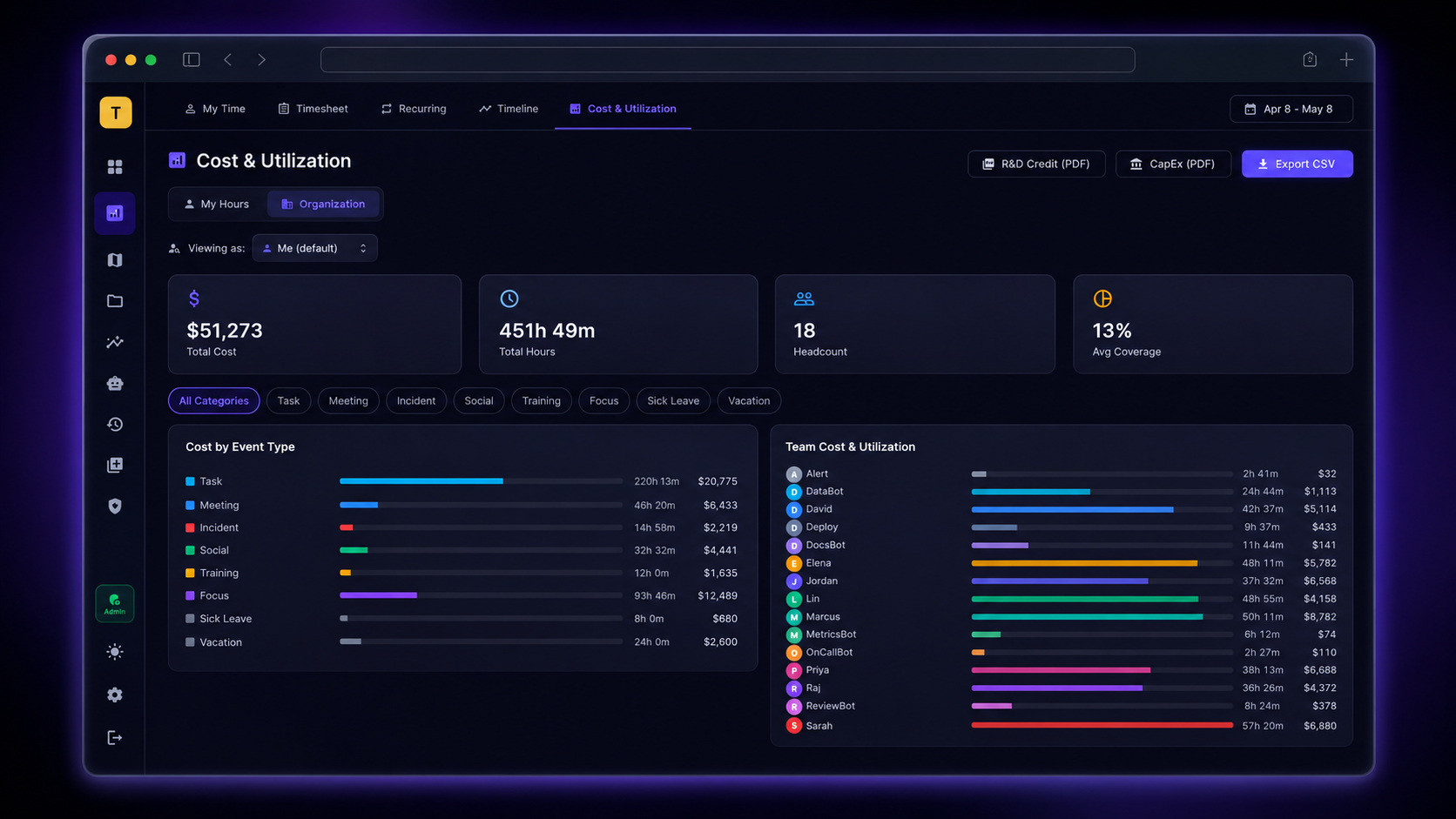
Manager + PMO view

The picture you used to ask a spreadsheet for. Live.

Allocation heatmaps. Project health with labor + non-labor in one column. OpEx/CapEx in real time — not at quarter-close.

  • Capacity heatmap. Every worker and agent — over, under, allocated.
  • Project cost, complete. Hours plus contractors, infrastructure, consulting.
  • OpEx / CapEx, live. Project-level classification as work happens.
  • Scenario planner. Move people across initiatives, see cost shift before you sign off.
  • Event cost ticker. Dollar weight on every recurring meeting and incident.
app.tymrlogic.com / cost-utilization
Tymr Cost & Utilization — capacity, utilization, and project cost rolled up
Cost & Utilization — live across teams Updated continuously
Executive view

One portfolio. One workforce. One lens.

Where capacity is spent, what comes back, how to shift the mix. Humans and agents costed together. Investment vs. run, board-ready.

  • Strategic cost-benefit. Capacity, cost, expected return — live, not quarterly.
  • Portfolio scenarios. Rebalance investment vs. run, human vs. agent, before committing.
  • Agent economics. Compute cost, agent capacity, and human review in one lens.
  • Board-ready. The numbers your finance lead opens on Friday — rolled up.
app.tymrlogic.com / portfolio
Tymr Portfolio — investment, run, labor and non-labor cost rolled up
Portfolio — investment, run, agent vs human Live
Compliance, as a byproduct

Because the data is real and lineage is preserved, the same ledger produces audit-ready artifacts for R&D credit, software capitalization, and DCAA — no quarterly survey.

Show the spec
  • IRC §41 — R&D credit. Contemporaneous documentation, per-employee, per-project — built from the ledger.
  • ASC 350-40 — software capitalization. OpEx/CapEx split with project-level evidence, in real time.
  • DCAA / FAR 31. Daily time tracking with a tamper-evident audit trail and lineage back to source.
See the compliance view →
Humans + Agents on one floor

The workforce includes agents now. So does the ledger.

AI agents aren't a sidebar. They consume compute, produce work, and show up in the same capacity and cost reports as humans.

One floor, one cost lens

Claude, Copilot, LangChain, and your custom agents — on the same grid as your team.

Tymr's open event substrate — UTEv1 — is the format both workforces emit into. Same shape for a Jira move and an agent run. Same attribution. Same cost. Tour the agent floor →

K. Ejibe · Auth-v2 reviewHuman
claude-agent-04 · PR triageAgent
S. Patel · Discovery interviewHuman
copilot-svc-02 · RefactorAgent
J. Liu · Portfolio syncHuman
Integrations

Nine sources. Six function groups. Every sector.

Functions, not industries, decide what plugs in.

Google Calendar Calendar
Microsoft Outlook Calendar
Slack Chat
Microsoft Teams Chat & meetings
Google Meet Meetings
Jira Ticketing
GitHub Dev tools
ServiceNow ITSM
Workday HRIS
Who it's for

Anywhere people and agents do work — and someone needs to know how much, on what, and at what cost.

Sector-neutral by design. The capacity question is the same everywhere — the answers just rhyme differently.

Engineering & Product

Per-team capacity. Where features are paying off. OpEx/CapEx without a survey.

Professional Services & Consulting

Billable vs. non-billable. Client utilization. Project margins live — not at month-end.

IT & ITSM

Where unplanned work goes — incidents, changes, problems — with cost attached.

PMO & Portfolio

Project health, capacity forecasts, scenarios — on numbers that aren't from a survey.

Non-profit & Public Sector

Grant- and program-level cost attribution — for delivery, not for the auditor's spreadsheet.

Agencies & Creative

Per-client hours. Project margin with vendors and freelancers. Capacity for the next pitch.

Want to see your own capacity, without asking your team for a single timesheet?

We'll connect a sample source and walk you through what your capacity actually looks like.